

Growing B2C businesses usually spend a great deal of time thinking about customer acquisition. More website traffic, more leads, more registrations, more appointments, and more first-time buyers all feel like clear signs of growth. Because those numbers are visible and relatively easy to track, acquisition often becomes the center of the conversation.
But acquisition is only one part of the revenue picture.
In many small and midsized businesses, there is already meaningful revenue potential sitting inside the customer database. The problem is that those customers are often grouped together instead of being understood according to their behavior, purchase history, and relationship with the business.
That was the central issue behind a customer retention and reactivation analysis I completed for a B2C company after a particularly strong sales period. The business had generated substantial customer participation, but the more useful question was what should happen next.
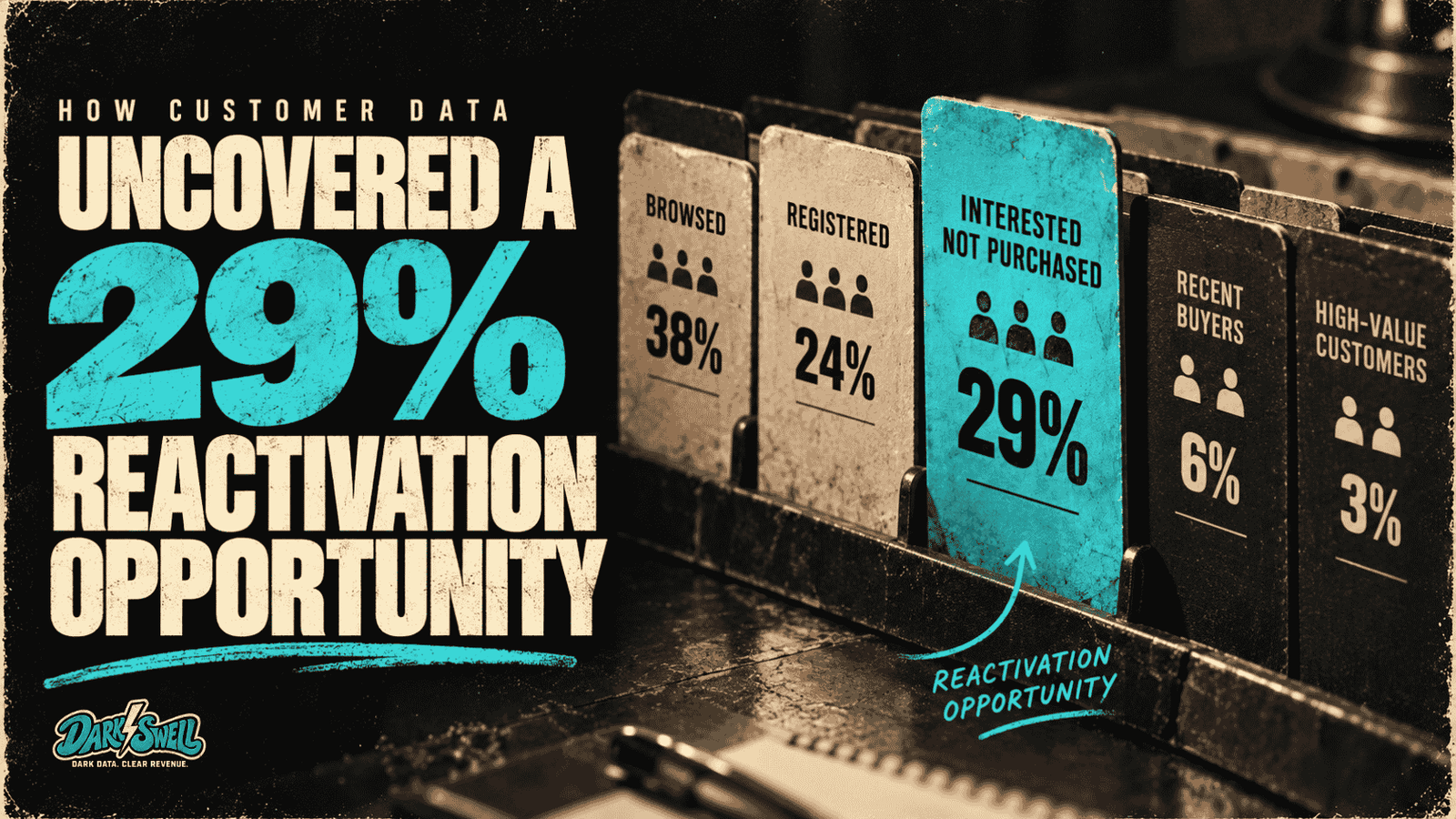
The analysis showed that the customer base was not one audience. It contained several distinct groups with different levels of intent, different purchasing histories, and different opportunities for future revenue. Some people had shown strong interest but had never completed a purchase. Others had recently purchased and represented an opportunity for retention. A smaller group of established customers was responsible for a disproportionately large amount of revenue.
Instead of treating all of those people the same, the goal was to understand what each group was already telling the business through its behavior.
The Customer Database Was More Valuable Than It Looked
One of the easiest mistakes for a growing business to make is viewing the customer database as one large marketing list.
Everyone receives the same emails. Everyone sees the same offers. Everyone is treated as though they have roughly the same relationship with the company.
But that is rarely true.
A person who created an account or registered for something but never completed a purchase is not the same as a first-time buyer. A first-time buyer is not the same as a repeat customer. A repeat customer who has spent significantly more than average may deserve a different level of attention altogether.
Once those differences become visible, the database stops being a list of contacts and starts becoming a map of customer behavior.
That shift matters because different customer behaviors usually require different business responses.
Some Customers Had Already Made It Most of the Way to a Purchase
One of the clearest opportunities in the analysis came from people who had shown real buying intent but had not completed a transaction.
These were not cold prospects who had never heard of the business. They had already taken meaningful steps. They had registered, engaged, or otherwise moved far enough into the buying process to demonstrate interest.
Something simply prevented the purchase from happening.
That distinction is important for any B2C company. A business may spend heavily trying to generate entirely new traffic while overlooking people who have already made it most of the way through the funnel.
The more useful question is not simply, “How do we get more leads?”
It is, “Why did these interested customers stop?”
The barrier could be price. It could be timing. It could be product availability, uncertainty, or simply not finding the right option at the right moment.
The original analysis recommended treating these customers as a reactivation audience rather than starting the acquisition process over from zero. It included gathering simple feedback about what prevented the purchase and using known customer interests to make future outreach more relevant.
The exact tactic would look different from business to business, but the underlying idea is broadly applicable.
A home-services company may have homeowners who requested an estimate but never scheduled the work. A fitness business may have people who completed a trial but never became members. An ecommerce company may have customers who repeatedly viewed a product category without purchasing. A dealership may have people who submitted an inquiry but never bought.
Those are not necessarily failed leads.
They may simply be unfinished customer journeys.
The First Purchase Was the Beginning of the Relationship, Not the End
The second opportunity centered on recent buyers.
Once someone has purchased, the relationship changes. The business no longer needs to convince that person that it exists or establish credibility from scratch. The customer has already crossed an important threshold.
The challenge becomes giving that customer a reason to stay engaged and eventually return.
That often requires a different approach from traditional promotional marketing.
Instead of immediately pushing another sale, the original analysis recommended extending the value of the first purchase with useful post-sale information relevant to what the customer had already bought.
For a retailer, that might mean care instructions or product education. For a home-services company, it could mean seasonal maintenance guidance. For a fitness business, it might mean helping a new member get better results from the service they already purchased. For a specialty ecommerce company, it could mean showing customers how to use, maintain, or expand what they already own.
The principle is simple: retention does not always begin with asking for another transaction.
Sometimes it begins by helping the customer get more value from the first one.
That keeps the relationship active without turning every interaction into another sales pitch.
High-Value Customers Deserved a Different Experience
The analysis also showed that a relatively small group of customers was responsible for a meaningful share of revenue.
That is a common pattern in B2C businesses, but it is not always acted on.
Companies often spend significant money attracting brand-new customers while giving their highest-value existing customers almost the exact same experience as everyone else.
The original recommendation was to provide a higher-touch experience for especially valuable customers through things like priority access and more personalized service.
For an SMB, this does not necessarily mean building an elaborate loyalty program.
It could mean early access to inventory, priority scheduling, personal outreach, exclusive previews, preferred service, or simply recognizing that someone who has demonstrated unusually high value to the business should not always be treated like a first-time visitor.
The important part is recognizing what the customer is already communicating through behavior.
If someone repeatedly chooses the business, spends more than average, or continues purchasing over time, that is information. The business can use it to decide where a more personal experience may be justified.
Existing Customers Could Also Help Guide Future Decisions
One of the more useful parts of the analysis went beyond retention and marketing.
The customer database could also help the company understand what people wanted next.
The original report recommended periodically asking existing customers what they were interested in purchasing and sharing useful market information back with them.
That creates a feedback loop between the customer and the business.
Instead of making every product, inventory, or service decision internally, a company can use actual customer behavior and direct feedback to help determine where future demand may exist.
For a retailer, that might influence inventory decisions. For a service business, it might uncover demand for an additional service. For a fitness company, it could expose interest in different programs or class times. For an ecommerce business, it may reveal adjacent product categories customers are already looking for.
Customer data is not only useful for explaining what already happened.
It can also help reduce uncertainty about what the business should do next.
Retention Is a Revenue Problem, Not Just a Marketing Problem
Small and midsized businesses often separate marketing, sales, customer service, and operations into different reporting conversations.
Marketing reports traffic and leads. Sales reports transactions. Customer service reports support activity. Operations reports fulfillment.
Each department may be accurately reporting its own numbers, but the customer does not experience the company as separate departments.
The customer experiences one relationship.
That relationship might begin with an advertisement, continue through a website, become a purchase, involve a support interaction, and eventually lead to another purchase.
Looking at the relationship across those stages creates much more useful business questions.
Where are interested customers stopping before they buy?
How many first-time customers ever return?
Which customers generate the most value over time?
What happens after the first purchase?
Which customer behaviors seem to signal stronger future value?
What could the business learn from people who showed interest but never converted?
Those questions move analytics away from simply describing performance and closer to helping the business decide what to do.
The Real Opportunity Was Already Inside the Business
The most important part of this project was not creating another report.
The company already had transaction history, customer activity, marketing data, and an existing database.
The opportunity came from connecting those signals in a way that changed the next business decision.
The analysis identified customers who had shown buying intent but had not converted, recent buyers who could be nurtured into repeat customers, and high-value customers who warranted a different relationship. It also showed how the broader customer base could become a source of information for future business decisions.
The final recommendations were translated into specific customer groups, actions, and timelines rather than being left as observations on a dashboard.
That is where analytics becomes useful for an SMB.
Not when the business has more numbers.
When the business has a clearer understanding of what those numbers mean, where the next opportunity is, and what to do next.