

Increasing an advertising budget is easy. Making that additional money work harder is the part that actually matters.
For this B2C business, I restructured and optimized its Meta advertising across Facebook and Instagram with one goal in mind: scale customer acquisition without simply paying more for the same results. From January through mid-May, year-over-year ad spend increased by approximately 31%, but the results increased much faster.
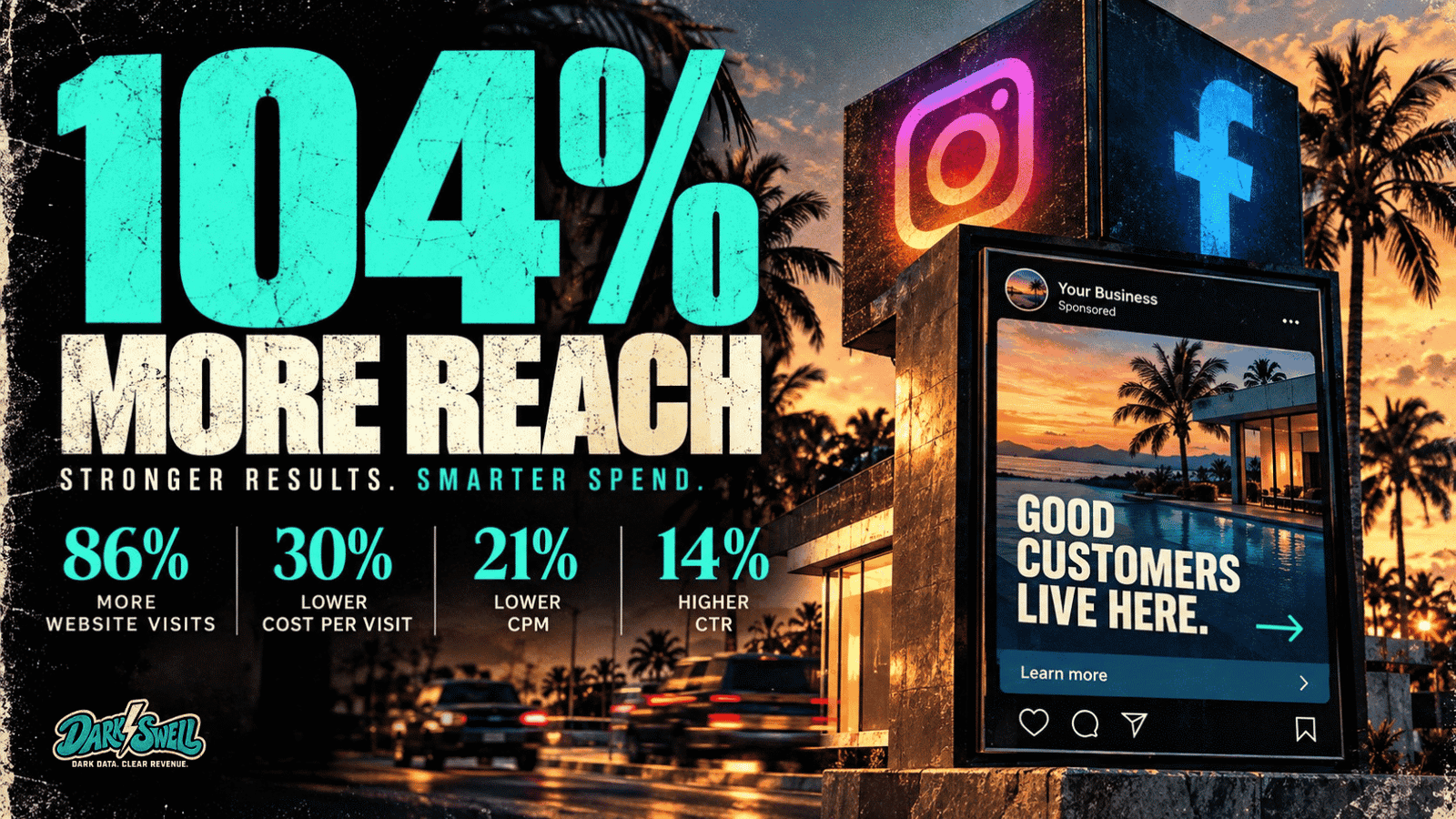
Unique reach grew 104%. Clicks increased 89%. Website visits increased 86%. At the same time, cost per click fell 31%, cost per website visit dropped 30%, CPM declined 21%, and click-through rate improved 14%.
The business was spending more because it was running more campaigns, but each advertising dollar was becoming more productive.
The Results
The Results
More reach, more website traffic, and lower acquisition costs.
| Metric | Previous | Optimized | Change |
|---|---|---|---|
| Ad Spend | $10,960 | $14,336 | +30.8% |
| Campaigns | 24 | 42 | +75.0% |
| Impressions | 1.26M | 2.09M | +65.8% |
| Unique Reach | 271K | 553K | +104.2% |
| Clicks | 36,887 | 69,762 | +89.1% |
| Landing Page Visits | 21,245 | 39,559 | +86.2% |
| CPM | $8.71 | $6.87 | −21.1% |
| CPC | $0.30 | $0.21 | −30.8% |
| CTR | 2.93% | 3.34% | +14.1% |
| Cost per Website Visit | $0.52 | $0.36 | −29.8% |
| Average Frequency | 4.65× | 3.77× | −18.8% |
Spending More Was Not the Goal
A lower cost per click can look good in a report and still mean very little to the business. Cheap traffic is only useful if it brings more potential customers into the journey.
That is why the work was not focused on one advertising metric. I looked at the entire acquisition path from ad exposure to website visit and evaluated how targeting, campaign structure, creative, and audience behavior were affecting one another.
The better question was not whether we could get cheaper clicks. It was whether we could reach more of the right people and move more of them into the business for less money per visit.
That distinction matters because paid media can look efficient inside Ads Manager while still doing very little for the rest of the business. A campaign can produce cheap clicks, high impressions, or a strong click-through rate and still send low-quality traffic to a weak landing page.
The goal was to improve the system, not just the ad account.
The Business Reached More Than Twice as Many People
Unique reach increased from roughly 271,000 people to 553,000, which represented a 104% increase in audience size on just 31% more spend.
At the same time, average frequency declined from 4.65 impressions per person to 3.77. That was an important signal because the growth was not coming from repeatedly serving more ads to the same audience.
The campaigns were reaching significantly more people while relying less heavily on repeat exposure. For a B2C company trying to grow, that is a much healthier pattern than increasing spend while audience saturation climbs with it.
If reach had grown while frequency also increased sharply, the account could have been spending more money simply to keep showing ads to the same people. Instead, the business was expanding its potential customer pool.
More People Responded to the Advertising
The larger audience also became more responsive.
Click-through rate improved from 2.93% to 3.34%, an increase of approximately 14%, while total clicks rose from roughly 37,000 to nearly 70,000.
That combination matters. If reach expands rapidly but engagement falls, the business may simply be buying broader but lower-quality exposure. Here, the opposite happened.
The campaigns reached more people and generated a stronger response rate from that larger audience.
That suggested the additional reach was not simply more volume. The advertising was becoming more relevant at the same time it was scaling.
Getting People to the Website Became Cheaper
Clicks are useful, but I wanted to know how many people actually made it to the website.
Landing page visits increased from 21,245 to 39,559, an 86% increase. At the same time, the cost of generating a website visit fell from $0.52 to $0.36.
That was one of the most important improvements in the account.
A click does not always become a website visit. Someone can click an advertisement and never successfully reach the site, leave before the page loads, or disengage almost immediately.
Tracking landing page visits helped move the conversation away from platform activity and closer to actual acquisition.
The business was not just buying more clicks. It was getting substantially more people onto the website for nearly 30% less per visit.
The Cost of Reaching and Acquiring Traffic Improved at the Same Time
Several major cost metrics improved simultaneously.
CPM dropped from $8.71 to $6.87, which meant the business was buying exposure more efficiently. Cost per click declined from $0.30 to $0.21 while total click volume nearly doubled. Cost per website visit fell from $0.52 to $0.36.
Normally, increasing spend can create pressure in the opposite direction. Costs rise as the easiest opportunities are exhausted, audiences become saturated, and additional reach becomes more expensive.
That did not happen here.
The account scaled while becoming more efficient.
That is a much stronger signal than simply looking at whether one campaign had a low CPC or whether total impressions increased.
The Work Went Beyond Ads Manager
Meta Ads Manager can tell you how many people saw an ad, how often they saw it, how many clicked, and what those clicks cost.
What it cannot tell you by itself is whether those people became better customers.
That is why paid media has to be analyzed as part of the broader acquisition system. The customer journey looked more like audience targeting, ad exposure, click, website visit, on-site behavior, conversion, and ultimately revenue.
Every stage can affect the performance of the next one.
Weak targeting can make good creative look ineffective. Strong creative can send traffic to a poor landing page. A great campaign can appear successful while weak tracking hides what customers actually do after arrival.
So the work included more than launching campaigns and watching cost per click.
I evaluated campaign structure, budget allocation, audience saturation, click-through behavior, landing-page traffic, and year-over-year acquisition costs together so the business could understand whether the system was actually improving.
What Changed
The account expanded from 24 campaigns to 42, but campaign volume by itself was not the objective.
The focus was on creating a structure that made it easier to understand what was working, where budget should move, which audiences could still be expanded, and where performance was starting to weaken.
That included separating campaign objectives more clearly, evaluating different audience groups, monitoring creative response, watching frequency for signs of fatigue, and comparing clicks with actual website visits.
Instead of treating every metric independently, the analysis connected them.
The business was reaching more people. Those people were responding at a higher rate. More of them were reaching the website. Traffic was becoming cheaper rather than more expensive. And growth was not being driven by repeatedly serving ads to the same audience.
Those are far more useful questions for an owner than whether a single campaign happened to have a low CPC last week.
Why This Matters for B2C Businesses
Any business can increase an ad budget. The harder question is what happens to efficiency after the increase.
If spend goes up 30% and traffic goes up 30%, the company has essentially purchased more of the same result.
In this case, spend increased 31% while reach grew 104% and website visits increased 86%. At the same time, cost per click fell 31% and cost per visit dropped almost 30%.
That meant the business was not simply buying more advertising.
Its acquisition system was becoming more efficient.
For a growing B2C company, that is the type of result that matters because it creates more room to scale without immediately creating the same level of cost pressure.
The DarkSwell Approach
DarkSwell does not treat paid media as an isolated channel.
Advertising affects website traffic. Website experience affects conversion. Conversion affects acquisition economics. Acquisition economics determine whether a business can continue scaling.
So the useful question is not whether the Facebook ads are “doing well.”
The better question is whether the business is acquiring more potential customers, more efficiently, and whether that growth is producing better business outcomes.
That is the question the reporting should be built to answer.
If your advertising reports stop at impressions, clicks, and spend, DarkSwell can help connect those numbers to the rest of the customer journey.