

The business already had a product people wanted, a functioning website, and real demand in the market. Organic traffic was coming in and revenue was being generated, but growth had started to flatten. The site was visible enough to keep producing business, yet not visible enough to support the next stage of growth the company expected. Traffic had plateaued, search visibility was no longer expanding in a meaningful way, and the gap between website activity and revenue growth was becoming harder to ignore.
Rather than assuming the answer was simply to publish more content or chase additional keywords, I started by trying to understand why the site had stopped growing. The problem turned out to be broader than technical SEO. The website was positioned around a market definition that was too broad and slightly misaligned with the intent of the people most likely to become customers. It was attracting visibility, but not consistently around the searches that carried the strongest business value.
That distinction mattered because more traffic would not have solved the underlying problem. The company could have continued producing content and increasing impressions while still bringing in the wrong mix of visitors. The real opportunity was to improve the alignment between the way the business presented itself, the people it was trying to reach, and the searches those people were actually making.
Repositioning the Site Around the Actual Buyer
The first major step was redefining who the website was really speaking to. I looked at the market more narrowly to identify the customers with the strongest fit, the problems they were trying to solve, and the language they were using when they searched for solutions. That work helped reveal where the existing positioning was too broad and where the site was missing opportunities to speak more directly to people with stronger buying intent.
From there, I repositioned the site around those customers. The messaging needed to make it clearer who the business was for, what problem it solved, and why it was relevant compared with the other options appearing in search. That repositioning became the foundation for the SEO work because there was little value in making the site more visible if the underlying message was still pointed at the wrong audience.
Once the market position was clearer, I rebuilt the SEO strategy around actual buyer intent rather than search volume alone. The existing site already had content and organic visibility, but the architecture did not consistently support the topics and search patterns most closely tied to revenue. I reorganized the content strategy around those opportunities and restructured the site so the most important pages had stronger internal support.
That included rethinking page hierarchy, internal linking, keyword alignment, and the relationships between major content areas. The objective was to create a site where positioning, content, and architecture all reinforced the same market opportunity. Instead of publishing pages simply because a keyword had volume, the strategy focused on where the business had a strong reason to compete and where search behavior overlapped with customer demand.
Rebuilding the Technical Foundation
The strategic work also needed a stronger technical base. I addressed the parts of the site that were limiting search performance and made sure the new architecture could be crawled, understood, and supported properly. Technical SEO was important, but it was treated as part of the larger strategy rather than as a separate checklist.
A technically sound website can still underperform if it is aimed at the wrong searches. In the same way, strong content can struggle if the site structure does not support it. The improvement came from getting those layers to work together: clearer positioning, stronger architecture, better search intent alignment, and a healthier technical foundation.
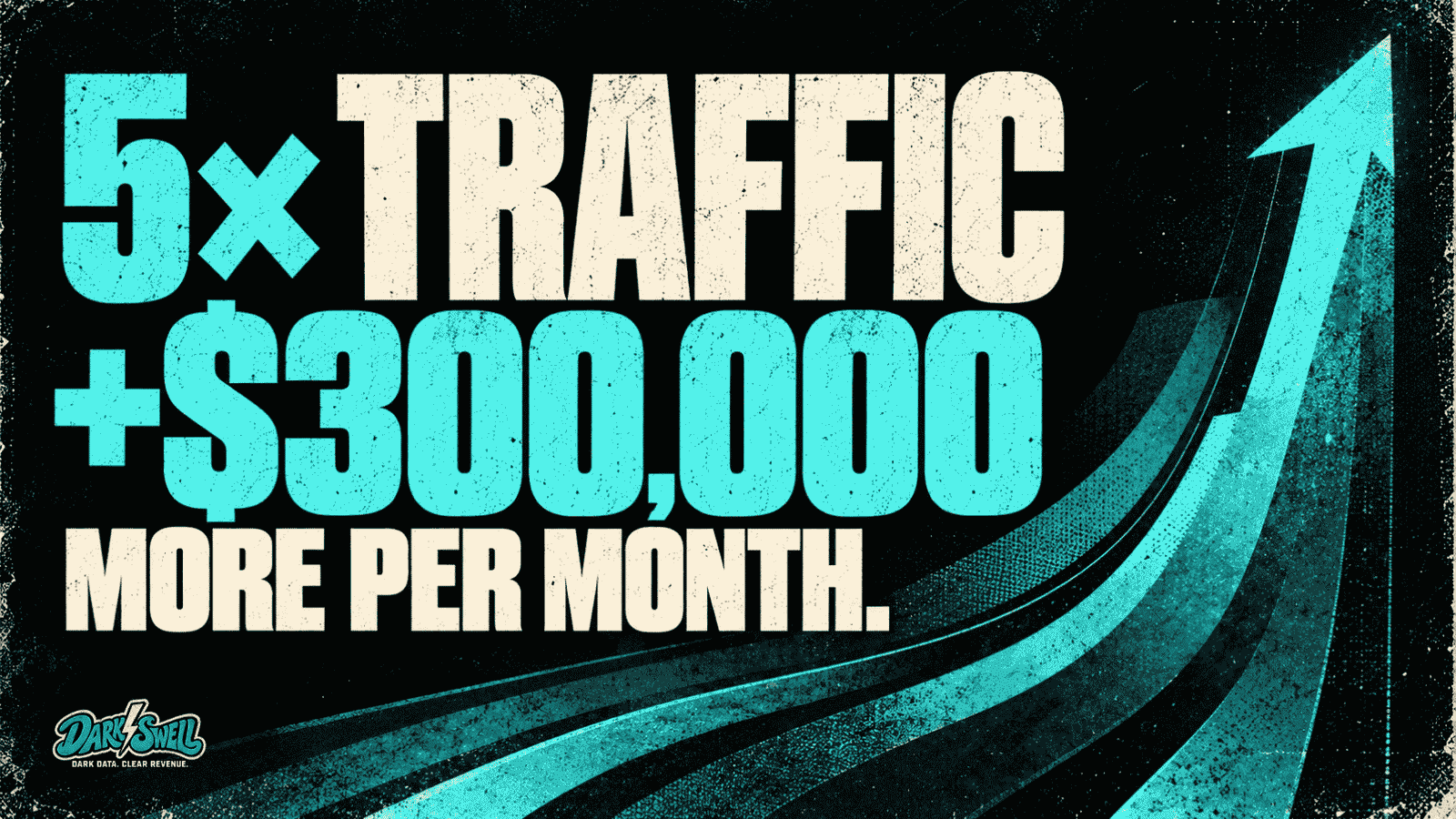
As those changes began to take hold, organic traffic increased to roughly five times its previous level. That was a substantial improvement in visibility, but traffic was not the result that mattered most. The more important change was what happened to revenue.
Revenue attributed to organic traffic increased by approximately $300,000 per month.
That showed that the growth was not being driven by empty traffic. The business was becoming more visible in searches that were more closely connected to actual customer demand, and the additional traffic was translating into measurable commercial value.
Why the Revenue Increase Mattered More Than the Traffic
It would be easy to focus on the five-times increase in organic traffic because it is the most obvious headline metric. But SEO can produce impressive traffic numbers while contributing very little to the business if the additional visitors are unlikely to buy.
That is why traffic alone was never the standard for success. The more useful question was whether the site was attracting more of the people the business actually wanted as customers.
The repositioning work changed that relationship. The company was not simply appearing in more searches. It was appearing more often in searches with stronger relevance to the problems it solved and the customers it served. That made the traffic more valuable and helped explain why the revenue increase was so significant.
The project also changed how the business approached search opportunities. Instead of assuming the largest keyword was always the most important one, the strategy focused on the relationship between search intent and commercial value. A broad keyword can bring in a large audience with relatively little buying intent, while a smaller and more specific search can be far more valuable if it closely matches what the business offers.
That shift made the SEO strategy much more disciplined. Content was no longer being created primarily to increase traffic. It was being built to strengthen the company’s position in the parts of the market where organic visibility could have the greatest business impact.
SEO Became Part of the Growth Strategy
One of the most important outcomes from this project was recognizing that SEO was not really a separate marketing activity. The search strategy reflected much larger decisions about who the business wanted to reach, how it wanted to be positioned, and where it believed future growth could come from.
The pages a company creates, the topics it targets, the language it uses, and the way its website is structured all communicate something about who the business believes its customer is. If that assumption is wrong, SEO can simply amplify the wrong message. When the positioning is right, search can do the opposite by making the business more visible in exactly the places where strong customers are already looking.
That was the shift in this case. The business did not need more content for the sake of content. It needed a clearer market position, a site structure built around that position, and an organic strategy that connected search behavior to real customer demand.
The DarkSwell Approach
DarkSwell treats SEO as part of the broader growth system rather than as a rankings exercise. Search visibility only becomes valuable when it helps a business attract more of the right customers and creates stronger revenue opportunities.
That means looking beyond keyword positions and traffic graphs to understand market positioning, customer intent, content architecture, technical performance, and what happens after someone reaches the website. The goal is not simply to increase organic traffic. It is to make sure the business is becoming more visible to the people most likely to become customers and that the visibility is creating measurable growth.
For this business, that shift turned a plateaued organic channel into roughly five times the traffic and approximately $300,000 in additional monthly revenue.