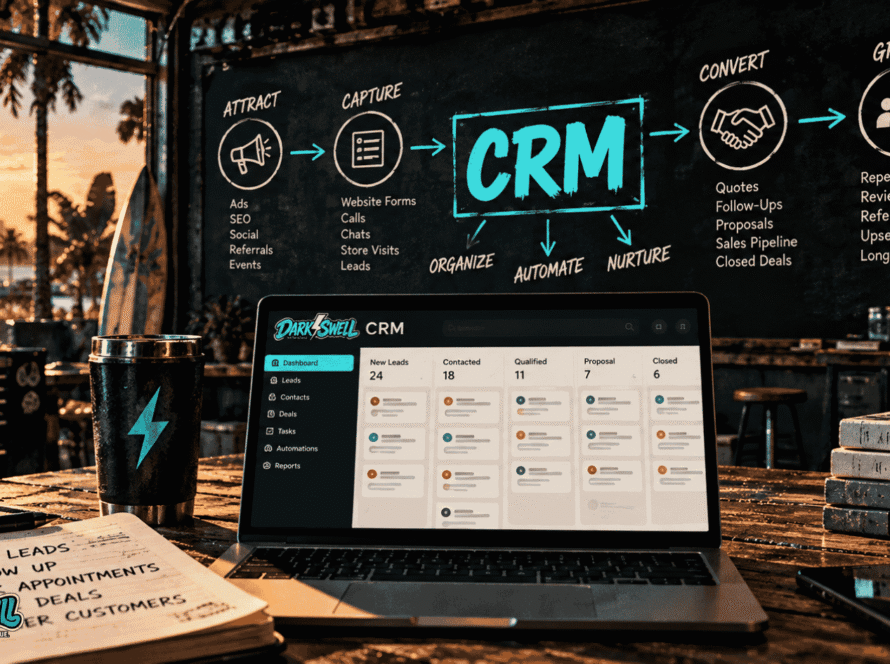
A sales cycle is the series of stages a potential customer moves through from the beginning of a sales opportunity to the final outcome of the sale. At its simplest, it describes what happens between identifying a possible customer and either winning or losing that business.
A simple sales cycle might move from a new lead to contact, qualification, an estimate or proposal, a decision, and finally a won or lost outcome. More complex businesses may include additional stages for discovery meetings, product demonstrations, financing, negotiations, approvals, contracts, technical reviews, or procurement.
There is no universal sales cycle that every business should use. A landscaping company, software provider, auto dealership, roofing contractor, manufacturer, law firm, and ecommerce company may all sell in very different ways. What matters is defining the stages that consistently describe how a potential customer moves toward a purchase.
Once those stages are clearly defined, the business can begin answering much more useful questions about its sales performance. How many opportunities are currently open? Where are they getting stuck? How many move successfully from one stage to the next? How long does a typical sale take? How many opportunities eventually become customers? The sales cycle provides the structure needed to answer those questions.
What Is a Sales Cycle?
A sales cycle is the sequence of stages involved in turning a potential customer into an actual customer. The cycle usually begins when a business identifies or receives a sales opportunity and ends when that opportunity reaches a final outcome.
That outcome might be a completed sale, a lost opportunity, a prospect who is disqualified, or an opportunity that is postponed or placed on hold. The exact starting point also varies depending on the business.
For a B2B company, the sales cycle might begin when a salesperson identifies a company worth contacting. For a home services company, it may begin when someone submits a quote request. For a dealership, it might begin when a shopper calls, fills out an online form, or walks onto the lot. For an ecommerce company, much of the sales cycle may happen digitally without direct involvement from a salesperson.
The underlying concept is the same in every case: the sales cycle gives a business a structured way to understand what happens between the initial opportunity and the final purchase decision.
What Is the Sales Lifecycle?
The terms sales lifecycle and sales cycle are often used interchangeably. Both generally refer to the progression of a sales opportunity from its beginning through a completed outcome.
Some businesses use the term sales lifecycle more broadly to describe the entire relationship with a customer, including what happens after the initial sale. In that context, the lifecycle might include onboarding, repeat purchases, renewals, upselling, cross-selling, retention, and eventually reactivation.
There is no universally enforced distinction between the two terms. What matters more is consistency inside the business. If sales, marketing, management, and operations all use different definitions for stages such as qualified lead, opportunity, estimate, or proposal, reporting becomes difficult regardless of what the overall process is called.
Why Is the Sales Cycle Important?
A defined sales cycle turns selling from a collection of individual conversations into a process that can be observed, measured, and improved.
Without defined stages, a business may know how many leads came in and how many sales were completed but have very little understanding of what happened between those two points. For example, if a company receives 200 leads during a month and closes 30 sales, it can calculate an overall lead-to-sale conversion rate. What that number cannot explain is why the other 170 opportunities did not become customers.
A defined sales cycle can provide far more context. The business may discover that 160 of those leads were successfully contacted, 120 were qualified, 90 scheduled appointments, 65 received estimates, 45 reached a final decision, and 30 became customers.
That immediately creates more useful questions. Maybe a large number of leads are never being contacted successfully. Perhaps appointments are being scheduled but customers frequently do not show. Maybe estimates are being delivered but follow-up is inconsistent. Or perhaps opportunities are moving normally through the entire process and simply require more time before a decision is made.
The sales cycle makes those differences visible.
What Are the Stages of a Sales Cycle?
Sales cycles are often described as having five, six, seven, or more stages, but there is no required number. The correct structure depends on how the business actually sells.
Most sales cycles, however, contain some variation of lead generation, qualification, discovery, presentation, decision, negotiation, and closing. Some businesses combine several of these stages, while others divide them into more detailed steps.
The goal is not to create as many stages as possible. The goal is to create enough structure to clearly understand where an opportunity currently stands and what needs to happen next.
1. Lead Generation or Prospecting
The sales cycle begins when a potential opportunity enters the business. This can happen through advertising, referrals, search engines, social media, networking, outbound sales, website forms, events, repeat customers, partnerships, or many other sources.
Some companies rely heavily on inbound leads generated through marketing. Others use salespeople to actively prospect for potential customers. Many businesses use a combination of both.
The important distinction is that not every person who interacts with the company is automatically a viable sales opportunity. Someone may download a guide, browse a product, call with a general question, or submit a form without being ready or able to buy. That is why the next stage, qualification, matters.
2. Lead Qualification
Qualification determines whether an opportunity is worth pursuing.
A qualified lead generally has a relevant need, the ability to purchase, appropriate timing, and enough alignment with what the company provides to justify continuing the sales conversation. The exact criteria depend entirely on the business.
A local service company may only need to determine whether the prospect is located inside its service area, needs a service the company provides, and is genuinely interested in receiving an estimate. A company selling a six-figure B2B product may need to understand the organization’s size, problem, budget, purchasing authority, timeline, technical requirements, and decision-making process.
Good qualification prevents a sales team from treating every inquiry as equally valuable and helps employees spend more time on opportunities that have a realistic chance of becoming customers.
3. Discovery
Discovery is the process of understanding what the potential customer actually needs.
Depending on the business, this might happen during a phone call, consultation, site visit, appointment, intake process, product demonstration, or formal discovery meeting. The purpose is to understand the customer’s problem, desired outcome, constraints, timing, budget, preferences, and other factors that may influence the purchase.
For simpler sales, qualification and discovery may happen during the same conversation. For more complex sales, discovery can involve several meetings and multiple decision-makers.
This stage is important because the quality of the eventual recommendation, estimate, or proposal depends heavily on how well the business understands what the customer is actually trying to accomplish.
4. Solution, Presentation, or Estimate
Once the business understands the customer’s needs, it can present an appropriate solution.
That solution might take the form of a product recommendation, service estimate, consultation, demonstration, customized proposal, scope of work, financing package, or formal presentation. The exact format is different from one business to another, but the purpose is the same: connect the customer’s problem with the product or service being offered.
In straightforward purchases, this stage may take only a few minutes. In more complex sales, it can involve technical demonstrations, multiple proposals, revised scopes, stakeholder meetings, or several rounds of discussion.
The quality of this stage often determines whether the customer feels the business understands the problem and whether the proposed solution feels appropriate.
5. Proposal and Decision
Once a customer has received enough information, the opportunity moves into some form of decision stage.
This does not necessarily mean the customer is ready to purchase immediately. They may compare competitors, review the proposal with a spouse or business partner, seek financing, request changes, wait for internal approval, verify references, review a contract, or simply take time to think.
This stage can be especially difficult for businesses to manage because an opportunity may appear close to closing without actually progressing. A proposal may sit unanswered for days or weeks while remaining technically open.
Without clear follow-up processes, sales pipelines can gradually fill with outdated opportunities that are unlikely to close. That makes it harder to distinguish real revenue opportunities from deals that simply have never been formally closed out.
6. Negotiation and Objection Handling
Not every sale requires formal negotiation, but most businesses encounter questions, concerns, or objections before a final decision is made.
Customers may have concerns about price, timing, features, scope, financing, contract terms, delivery, implementation, risk, or competing alternatives. In some cases, those objections can be resolved by providing more information or adjusting the proposed solution. In other cases, the objection may reveal that the opportunity is not a good fit.
The purpose of this stage is not simply to pressure someone into purchasing. It is to understand what is preventing the customer from making a decision and determine whether that barrier can reasonably be addressed.
Good sales cycle management also recognizes when continued pursuit no longer makes sense.
7. Close: Won or Lost
Every sales opportunity eventually needs an outcome.
If the customer purchases, the opportunity is typically closed as won. If they choose another provider, decide not to purchase, fail qualification, stop responding, or otherwise discontinue the process, the opportunity may be closed as lost.
Recording lost opportunities is just as important as recording successful ones. A business that consistently documents why sales are lost can begin identifying patterns related to price, competition, response time, product availability, financing, service area, salesperson performance, or other parts of the process.
Closing opportunities accurately also keeps the sales pipeline realistic. Otherwise, old deals can remain open indefinitely and create the impression that more potential revenue exists than is actually likely to materialize.
Sales Cycle vs. Sales Process
The terms sales cycle and sales process are closely related, but they describe different things.
The sales cycle describes the stages an opportunity moves through. The sales process describes what the business or salesperson does within those stages.
For example, one stage of a sales cycle might be “Estimate Sent.” The sales process could define what happens after the estimate is delivered: confirm receipt, schedule a follow-up task, call the customer after two business days, document the conversation, and move the opportunity to the appropriate next stage.
The sales cycle describes where the opportunity is. The sales process describes what should happen while it is there.
That difference becomes increasingly important as sales teams grow because a defined process makes it easier for multiple employees to handle opportunities consistently.
Sales Cycle vs. Sales Pipeline
A sales cycle describes the route an individual sales opportunity can travel. A sales pipeline shows all of the active opportunities currently moving through that route.
For example, a business may currently have 25 new leads, 18 qualified opportunities, 12 appointments scheduled, nine estimates outstanding, and four customers considering a final decision. Those opportunities collectively make up the sales pipeline.
The stages they move through make up the sales cycle.
This distinction matters because a business can have a well-defined sales cycle but still have a weak pipeline if there are not enough active opportunities entering or progressing through it.
Sales Cycle vs. Marketing Funnel
A sales cycle should also be distinguished from a marketing funnel.
The marketing funnel usually describes how people move from awareness and interest toward becoming a lead or customer. The sales cycle focuses more specifically on what happens once a potential sales opportunity exists.
There can be significant overlap between the two.
A person may discover a company through Google, read several articles, visit the website multiple times, follow the company on social media, and eventually submit a quote request. Much of that activity may be considered part of the marketing funnel. Once the quote request becomes an active opportunity and someone begins working toward the sale, the customer has entered the sales process.
Exactly where marketing ends and sales begins depends on how the business is organized. In companies with well-connected systems, the distinction can become less important because the same customer record may carry information through both marketing and sales.
What Is a Full Sales Cycle?
A full sales cycle usually refers to the complete process from the earliest sales activity through closing the customer.
A salesperson managing the full sales cycle may be responsible for prospecting, qualification, discovery, presentations, estimates, proposals, negotiation, follow-up, and closing. In other organizations, those responsibilities may be divided among several specialized roles.
For example, one team might generate and qualify leads before passing them to account executives who conduct discovery meetings and close the sale. A larger organization may have additional employees responsible for sales engineering, proposals, contracts, procurement, or implementation.
Small businesses are more likely to have employees who manage the full sales cycle because teams are smaller and responsibilities tend to overlap.
What Is Sales Cycle Length?
Sales cycle length measures how long it typically takes an opportunity to move from the beginning of the sales process to a completed sale.
A basic calculation is to add the number of days required to close a group of successful sales and divide that total by the number of sales.
For example, if five customers took 10, 20, 25, 30, and 40 days to close, those sales required a combined 125 days. Dividing 125 by five produces an average sales cycle length of 25 days.
That number can be useful, but averages should be interpreted carefully. Different products, customer types, lead sources, salespeople, and deal sizes may have very different buying timelines.
A business selling both $500 services and $50,000 projects may learn very little from combining all of those opportunities into one average. Breaking sales cycle length into meaningful groups often produces much better information.
What Affects the Length of a Sales Cycle?
Sales cycle length can vary enormously between businesses and even between customers inside the same business.
Price is one of the most obvious factors. Higher-cost purchases usually involve more consideration because the financial risk is greater. The number of decision-makers matters as well. A homeowner making an individual purchase can often decide much faster than a company requiring approval from executives, finance, procurement, legal, IT, and operations.
Complexity also affects the timeline. Customized products and services often require more discovery, evaluation, and communication than standardized purchases. Urgency can have the opposite effect. An emergency plumbing repair may be purchased almost immediately, while a homeowner considering a future remodel may spend months researching options.
Competition, financing, lead source, and the quality of the sales process itself also influence the timeline. Slow responses, missed follow-ups, confusing proposals, scheduling delays, and inconsistent communication can all extend a sales cycle unnecessarily.
The goal is not necessarily to make every sales cycle as short as possible. The more useful question is whether the length is appropriate for the type of purchase and whether avoidable delays are being introduced by the business.
What Is Sales Cycle Management?
Sales cycle management is the process of monitoring how opportunities move through the stages of a sale and improving that movement when necessary.
Instead of looking only at the final number of sales, the business examines what is happening throughout the process. That may include the number of opportunities entering each stage, conversion rates between stages, time spent in each stage, overall sales cycle length, pipeline value, follow-up activity, lead response time, win rate, reasons opportunities are lost, and differences between salespeople or lead sources.
The purpose is not simply to increase activity. It is to understand whether opportunities are progressing normally and where friction may be preventing otherwise viable sales from moving forward.
For example, if a business has plenty of leads but very few scheduled appointments, the issue may exist near the beginning of the cycle. If appointments are strong but very few estimates become customers, the problem may exist later.
Looking at the cycle stage by stage makes those differences easier to identify.
How Does a CRM Help Manage the Sales Cycle?
A CRM, or customer relationship management system, is one of the most common tools businesses use to track sales cycles.
Each sales opportunity can be assigned a stage inside the CRM. As the customer progresses, the opportunity moves from one stage to the next. A simple pipeline might move from new lead to contacted, qualified, appointment, estimate, decision, and finally won or lost.
The CRM can also store information connected to each opportunity, including communication history, notes, tasks, appointments, estimated sales value, lead source, expected close date, products or services of interest, and reasons a deal was lost.
This creates a structured record of what is happening across the entire sales pipeline.
Managers can see not only how many opportunities exist, but where those opportunities currently stand. Many CRMs can also automate administrative parts of the process by assigning leads, creating follow-up tasks, sending reminders, recording communication, or alerting employees when an opportunity has remained in one stage for too long.
The sales cycle provides the structure. The CRM provides a system for tracking that structure across many customers and employees.
How Do You Measure Sales Cycle Performance?
Sales cycle performance is best understood through several measurements rather than one number.
Lead-to-sale conversion rate measures the percentage of leads that eventually become customers. Stage conversion rate looks more closely at movement between individual stages. If 100 estimates are sent and 40 become sales, for example, the estimate-to-sale conversion rate is 40 percent.
Win rate measures the percentage of qualified opportunities that ultimately become customers. Average sales cycle length shows how long successful opportunities typically take to close, while time in stage reveals how long opportunities tend to remain at specific points in the process.
Pipeline value estimates the potential revenue represented by currently open opportunities, and average sale value helps show how much revenue a successful transaction typically produces.
Looking at those measurements together provides a much clearer picture than simply counting the total number of leads or sales.
How Can a Business Improve Its Sales Cycle?
Improving a sales cycle does not always require adding more sales activity. Often, the biggest gains come from removing unnecessary friction.
Responding to new leads quickly is one example. Potential customers often contact multiple businesses, so long response times can allow competitors to begin the sales conversation first.
Clear stage definitions also matter. Employees should understand exactly what needs to happen before an opportunity moves from one stage to another. A vague stage such as “working” may tell the business very little about whether meaningful progress is actually occurring.
Consistent qualification can improve efficiency by reducing the amount of time spent pursuing opportunities that are unlikely to purchase. Clear next actions also help. Every active opportunity should ideally have a defined next step, whether that is a phone call, appointment, estimate, meeting, follow-up, contract, or decision date.
Businesses should also pay attention to lost opportunities. Recording a sale as simply “lost” provides very little information. Tracking meaningful reasons for lost sales can reveal patterns that would otherwise remain hidden.
Automation can help with repetitive administrative work such as reminders, lead assignment, task creation, and certain follow-up communications. The purpose of automation should be to support the sales process, not replace interactions that genuinely require a person.
Finally, businesses should compare different groups instead of relying entirely on company-wide averages. Sales cycle performance may vary substantially by salesperson, product, location, customer type, lead source, or deal size.
Example of a Sales Cycle
Consider a local HVAC company.
A homeowner searches online for air conditioning replacement and submits a form requesting an estimate. That creates a new lead. An employee calls the homeowner, confirms the property is inside the company’s service area, and determines that the customer needs a system the company provides.
An in-home consultation is scheduled, and a technician visits the property. After evaluating the home and discussing the customer’s needs, the technician recommends a system and provides an estimate.
The homeowner does not immediately accept. They compare another quote, ask questions about financing, and take several days to decide. During that period, the opportunity remains open and follow-up tasks are scheduled.
If the homeowner approves the estimate, the opportunity is marked as won and installation is scheduled. If they choose another company or decide not to replace the system, the opportunity is closed as lost.
If the HVAC company tracks those stages consistently, it can eventually see much more than the total number of systems sold. It can understand how many website leads become appointments, how many appointments produce estimates, how many estimates become sales, how long decisions usually take, which lead sources produce the strongest opportunities, and where potential revenue tends to disappear from the process.
That is the practical value of a defined sales cycle.
Sales Cycle Frequently Asked Questions
What does sales cycle mean?
A sales cycle is the sequence of stages a potential customer moves through from the beginning of a sales opportunity until the opportunity is won, lost, or otherwise closed.
How many stages are in a sales cycle?
There is no universal number. Many models use five to seven stages, but businesses should define stages based on how their customers actually buy and how their sales process operates.
What is the first stage of the sales cycle?
The first stage is usually lead generation, prospecting, or the creation of a new sales opportunity. The exact starting point depends on the business.
What is the final stage of the sales cycle?
The final stage is typically closing the opportunity as won or lost. Some businesses also use outcomes such as disqualified, postponed, or no decision.
What is a CRM sales cycle?
A CRM sales cycle is a sales cycle represented and tracked inside customer relationship management software. Opportunities are assigned to stages and moved through the system as the sale progresses.
What is the difference between a sales cycle and a sales process?
The sales cycle describes the stages an opportunity moves through. The sales process describes the activities, methods, and procedures employees use to move the opportunity through those stages.
What is the difference between a sales cycle and a sales pipeline?
The sales cycle is the sequence of stages an opportunity can move through. The sales pipeline represents all of the active opportunities currently moving through those stages.
What is a long sales cycle?
There is no universal definition of a long sales cycle. Length depends on the product, price, industry, customer, complexity, and number of decision-makers involved. A six-month sales cycle could be extremely long for one business and completely normal for another.
How can you shorten a sales cycle?
Businesses can sometimes shorten sales cycles by improving response times, qualifying opportunities more effectively, defining clearer next steps, following up consistently, simplifying proposals, reducing scheduling delays, and removing unnecessary friction from the buying process.
The objective should not simply be speed. A shorter sales cycle is only beneficial if the business maintains good qualification, customer experience, and sales quality.
From Sales Cycle to Sales System
A sales cycle gives a business a framework for understanding how opportunities move from initial interest to revenue. By itself, however, the framework is only a model. It becomes much more useful when the business can consistently track the customers and opportunities moving through it.
That is where systems such as a CRM become important. A CRM can give each opportunity a record, assign it to the appropriate stage, preserve communication history, schedule follow-up, and show the business what is happening across the entire sales pipeline.
Understanding the sales cycle explains the path a potential customer takes toward becoming a customer. Understanding CRM explains how businesses can organize and manage that path as the number of customers, employees, and sales opportunities grows.